 comparison
Gas Safety Certificate vs Boiler Service
Table of Contents
- Gas Safety Certificate vs Boiler Service: The Core Difference
- What Is a Gas Safety Certificate?
- What Is a Boiler Service?
- How Often Should a Boiler Be Serviced?
- What Is Included in a Landlord Gas Safety Check?
- Can You Get Both Services at the Same Time?
- Why Landlords Need Both Services
- Conclusion
- Frequently Asked Questions
Last Updated: September 19, 2026
Gas Safety Certificate vs Boiler Service: The Core Difference
Understanding the distinction between a gas safety certificate and a boiler service is essential for every landlord, as a gas safety certificate boiler service combines two separate legal and maintenance requirements. These are two separate legal and maintenance requirements, and confusing them can leave you non-compliant with regulations or expose your tenants to risk.
Here's the fundamental difference: a gas safety certificate proves that your gas appliances are safe to use right now. A boiler service keeps your heating system running efficiently and safely over time. One is a legal compliance document. The other is preventive maintenance. You need both.
At PPS Property Management, we help landlords navigate these requirements seamlessly. Many landlords think one covers the other, or assume they're optional if the other is done. Neither is true. This guide breaks down exactly what each involves, who must do them, how often they're needed, and why skipping either one creates serious problems.
What Is a Gas Safety Certificate?
A gas safety certificate (formally called a Landlord Gas Safety Record or CP12) is a legal document proving that a Gas Safe registered engineer has inspected all gas appliances in your property and found them safe to use. It's not a service. It's a compliance record.
The certificate is issued after the inspection and remains valid for 12 months. Without it, you're breaking the law. The Health and Safety Executive (HSE) enforces this requirement under the Gas Safety (Installation and Use) Regulations 1998.
Think of it as a safety audit that says: "On this date, everything checked out." It doesn't mean your boiler will run perfectly for the next year. It means it was safe when tested.
Legal requirements for landlords
The law requires you to:
- Have all gas appliances inspected by a Gas Safe registered engineer annually
- Obtain a CP12 certificate within 28 days of the inspection (Gas safety - landlords and letting agents)
- Provide a copy to your tenant within 28 days
- Keep a copy for your records for at least two years
- Ensure the certificate is valid before a new tenant moves in
Failure to comply can result in significant penalties and liability issues.
The HSE can inspect your property at any time to verify compliance. If you can't produce a current CP12, you're in breach.
What the landlord gas safety record CP12 covers
The CP12 certificate documents the inspection of:
- Boilers and heating systems
- Gas cookers
- Gas fires and fireplaces
- Gas water heaters
- Any other gas appliances in the property
The engineer checks each appliance for safety hazards, including gas leaks, carbon monoxide risks, and faulty components. They test ventilation, check seals and connections, and ensure everything meets safety standards.
The certificate records the results for each appliance. It shows whether each one passed inspection or failed (meaning it's unsafe and must be repaired or removed).
What Is a Boiler Service?
A boiler service is routine maintenance performed by a qualified heating engineer. It keeps your boiler running efficiently, safely, and reliably. Unlike a gas safety certificate, which is a compliance inspection, a service is preventive care.
During a boiler service, the engineer cleans internal components, checks for wear, tests performance, adjusts settings, and identifies any issues before they become serious problems. A well-serviced boiler is less likely to break down, uses less fuel, and lasts longer.
Maintenance versus certification
This is where confusion starts. A boiler service is maintenance. A gas safety certificate is certification.
A service engineer may perform many of the same checks as a Gas Safe inspector, but the purpose is different. The service focuses on keeping the boiler working well. The safety certificate focuses on proving it's safe to use.
You can have a boiler serviced and still need a separate gas safety certificate. Some engineers offer combined packages where they perform both the service and the safety inspection in one visit, issuing the CP12 at the end. This is efficient and common, but it's still two separate functions.
Many landlords assume that if their boiler has been serviced, they're compliant with the gas safety certificate requirement. They're not. The service is about maintenance. The certificate is about legal proof of safety.
How Often Should a Boiler Be Serviced?
Industry best practice recommends servicing your boiler annually, typically before the heating season starts (autumn). Annual servicing catches small issues before they become expensive repairs and keeps your system efficient.
Some newer boilers come with manufacturer warranties that require annual servicing to remain valid (Common mistakes that can invalidate your boiler warranty). If you skip the service, you may void the warranty and lose coverage for repairs.
Older boilers (over 10 years) benefit from more frequent servicing, sometimes twice yearly, depending on their condition and usage.
If your boiler breaks down outside the service schedule, you'll need emergency repairs. Regular servicing reduces the likelihood of unexpected breakdowns and keeps your tenant's heating reliable.
What Is Included in a Landlord Gas Safety Check?
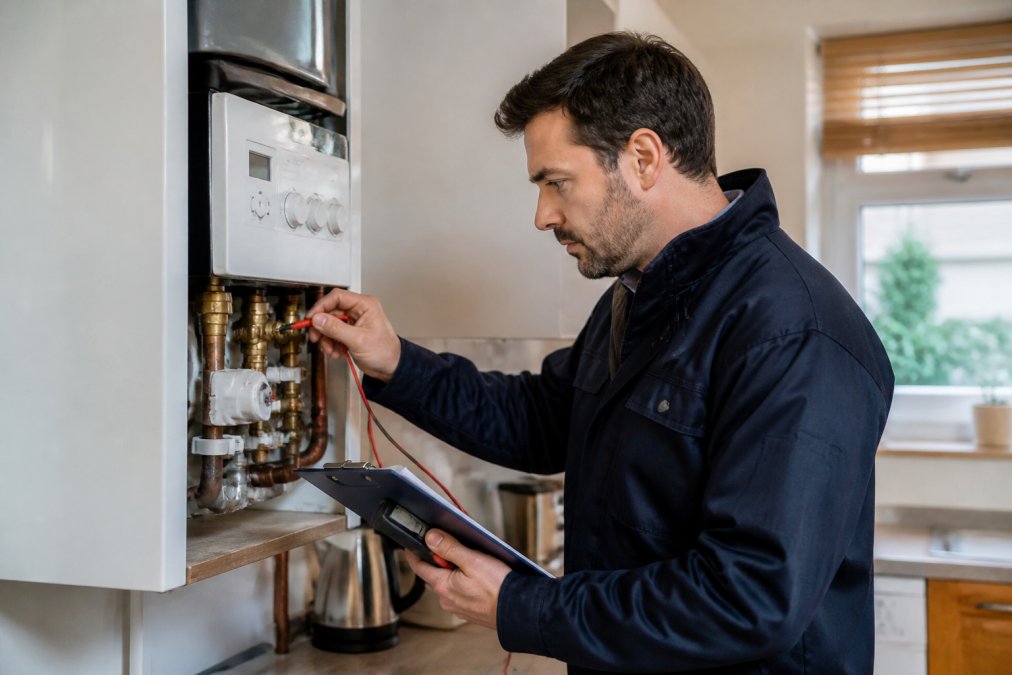
A landlord gas safety check covers all gas appliances and their installation. The Gas Safe engineer inspects:
- Boiler condition and operation - checks that it heats water and provides heating correctly
- Gas supply and pipework - tests for leaks using specialist equipment
- Ventilation and flue - ensures safe removal of combustion gases
- Safety devices - checks that controls, thermostats, and safety cutouts work
- Carbon monoxide risk - checks for signs of unsafe combustion or poor ventilation
- Gas cooker or hob - checks ignition, flame colour, and safety controls
- Gas fire or water heater - checks operation and safety features
- Seals and connections - inspects all joints and connections for wear or damage
The engineer uses specialist equipment to measure gas pressure, test for leaks, and check combustion efficiency. They'll also visually inspect for corrosion, damage, or signs of poor installation.
If they find any fault, they mark it on the certificate as either "At risk" (must be fixed immediately) or "Defects found" (should be repaired soon). An "At risk" fault means the appliance is unsafe and cannot be used until repaired.
The entire check typically takes 30-60 minutes, depending on how many appliances are present.
Can You Get Both Services at the Same Time?
Yes. Many engineers offer combined packages that include both a boiler service and a gas safety inspection in a single visit, often marketed as a gas safety certificate boiler service package. This is efficient and cost-effective.
During a combined appointment, the engineer will:
- Service the boiler (clean, adjust, test performance)
- Conduct the full gas safety inspection (check all appliances and installations)
- Issue the CP12 certificate at the end
The engineer must be Gas Safe registered to legally issue the CP12.
Why Landlords Need Both Services
Skipping either requirement creates different problems.
Without a gas safety certificate, you're breaking the law. The HSE can fine you, tenants can report you, and you have no legal defence. Your landlord insurance may not cover incidents involving unregistered appliances. If a tenant is harmed by a gas appliance and you have no current CP12, you could face personal liability.
Conclusion
The difference is clear: a gas safety certificate proves your appliances are safe right now. A boiler service keeps them running well over time. Both are legally required for rental properties, and both protect your tenants and your business.
Frequently Asked Questions
Is a gas safety certificate a legal requirement for landlords?
Yes. Under the Gas Safety (Installation and Use) Regulations 1998, landlords must obtain a gas safety certificate (CP12) for every rental property with gas appliances. The certificate must be renewed annually, and a copy must be provided to tenants within 28 days of the inspection. Failure to comply can result in significant penalties and liability issues.
Does a boiler service include a gas safety check?
Not necessarily. A boiler service focuses on maintenance and performance, whilst a gas safety check verifies that all gas appliances are safe to use. Some engineers offer combined packages that include both, but they serve different purposes. A service keeps your boiler running efficiently; a safety check ensures it meets legal standards. Many landlords arrange both in the same visit for convenience.
How often should a boiler be serviced to maintain warranty and efficiency?
Annual boiler servicing is recommended to maintain efficiency, extend the boiler's lifespan, and keep manufacturer warranties valid. Most boiler warranties require annual servicing as a condition. Regular servicing also helps catch minor issues before they become expensive repairs, potentially saving money on emergency call-outs and energy bills.
Can a Gas Safe engineer perform both a boiler service and a gas safety check at the same time?
Yes. Many Gas Safe registered engineers offer combined appointments where they perform both the boiler service and the gas safety inspection in a single visit. This approach is convenient and cost-effective for landlords, as it reduces the need for multiple engineer visits and ensures both compliance and maintenance are handled together.
What happens if I don't have a valid gas safety certificate when a tenant moves in?
Renting a property without a valid gas safety certificate is illegal and can result in prosecution, significant penalties, and claims for compensation from tenants. Additionally, your landlord insurance may be invalidated. It's essential to arrange the inspection and obtain the CP12 before a tenant occupies the property, and to renew it annually throughout the tenancy.